
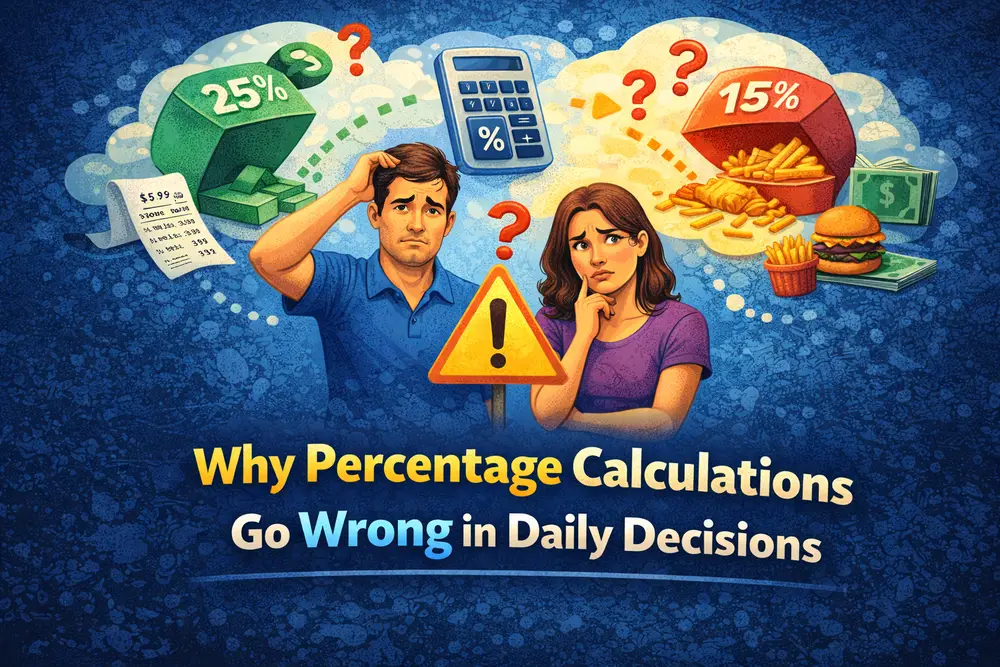
Percentages appear harmless. They show up while shopping, negotiating salaries, tracking weight changes, calculating interest, or understanding exam results. Most people feel comfortable with them, yet the moment real numbers enter the picture, confusion creeps in. A discount feels bigger than it is. A percentage increase seems identical to a percentage decrease. A small miscalculation quietly alters a financial decision or personal plan. These errors are rarely about intelligence. They come from how percentages interact with context, assumptions, and mental shortcuts people rely on without noticing.
Why this problem happens
Percentages are relative by nature, not absolute. Ten percent only makes sense when the base number is clear, but everyday situations rarely slow down enough to highlight that base. A salary increase of ten percent sounds equal to a ten percent cut later, even though the numbers no longer match. Discounts stacked together feel additive, though they multiply quietly in the background. Human intuition prefers round figures and shortcuts, while percentages demand precision. This mismatch creates gaps where errors slip in unnoticed.
How people usually try to handle it manually
Most people fall back on mental math or rough estimates. Some convert percentages into fractions in their head. Others move decimal points and hope the result feels reasonable. In shopping scenarios, people often subtract a percentage directly from the price without checking whether taxes, additional discounts, or base prices have changed. These approaches work sometimes, but they fail when numbers grow larger, when multiple percentages interact, or when increases and decreases occur sequentially. Small inaccuracies compound, and confidence masks the mistake.
A more practical way to deal with this
Instead of relying on mental shortcuts, it helps to separate the thinking from the calculation. The idea is not to become better at math under pressure, but to remove pressure altogether. When the calculation becomes mechanical and neutral, judgment improves. This approach treats percentages as inputs rather than guesses, allowing decisions to be made with clarity rather than assumption.
How a simple online tool helps in this situation
A percentage calculation tool removes ambiguity by forcing the base number and the percentage to be explicit. It handles increases, decreases, comparisons, and conversions consistently every time. Students use it to verify exam scores, shoppers to understand real discounts, freelancers to calculate commission changes, and individuals tracking health metrics to avoid misleading progress assumptions. By eliminating mental shortcuts, the tool reduces quiet errors that usually go unnoticed until consequences appear.
Situations where this approach is especially useful
Percentage mistakes are most costly when decisions build on each other. Salary negotiations, loan interest comparisons, weight tracking, investment growth, price markups, and tax calculations all rely on accurate percentage interpretation. Even small misunderstandings can distort long-term outcomes. Using a consistent calculation method keeps decisions grounded in reality, especially when numbers shift over time or stack together in ways intuition struggles to follow.
Final thoughts
Percentage errors are less about math skills and more about human perception. The brain prefers simplicity, while percentages demand context. When decisions matter, clarity matters more than confidence. Removing guesswork allows percentages to serve their purpose rather than mislead. Accuracy does not require complexity, only consistency and the willingness to verify what intuition assumes.


Leave a Reply